Urban(needs)M
Urban Sustainability - Complexity and Continuous Dynamics
The city is one of humankind’s most complex creations. It expresses the multidimensionality of urban life, combining the physical dimension with the human dimension. These dimensions, including society, culture and spirituality together with ecology, technology and economics, create an ever-changing dynamic system due to the ongoing interactions among all of the system’s components. Urban sustainability, more than being an environmental strategy for conserving environmental resources, is a mean for turning cities, the open spaces and buildings around us into more humane places adapted to users, geography and the local climate. The great complexity that characterizes cities and sustainability makes it difficult to examine and implement action plans. Development of an effective policy for implementing and changing urban trends in the city requires a multi-systematic, combined approach that provides a basis for the city’s social, cultural and environmental development. Urban development must integrate the material with the immaterial and become a part of the social vision. Correct municipal conduct should fluctuate between global thinking and local action, developing a unique, 'glocal' cultural identity. Even though the city is an independent, autonomous unit that functions by itself as a complete system, according to the holistic approach it is also a part of a larger system. The many factors that act on the city necessitate a multidisciplinary planning policy guided by flexibility, creativity and openness to change. Following the recognition that consumption and unwise use of technology cause changes to natural ecosystems and disturb the ecological balance required by symbiotic systems, environmental responsibility must become a way of life.
The necessary connection between technology and nature’s wisdom is expressed by Daffara:
"City form in the future, I believe, must follow function and function will be reassessed to follow life" .(2)
Daffara’s comment combines the modernistic approach, that urban planning provides a linear and rational solution for humankind’s functional requirements, with the broad approach that sees planning as a multi-dimensional, adaptive system that provides a solution for the future existence of life systems on Earth. This approach sees nature as a source of inspiration and learning. Using these tools it is possible to estimate anew the solutions for human requirements as part of a complex system based on insights from nature. This understanding is valid for cities in the present that consume resources and create waste at unprecedented scale and scope. Resource turnover in most cities is linear and concern for the source or final destination of the by-products and waste is almost non-existent. The result is dwindling, non-renewable resources and continuous and irreversible pollution. Therefore the ecological, social and economic urban systems must formulate action plans that imitate nature’s cyclical system, and adopt the natural approach that acts from ‘cradle to cradle’. Due to the many implications of trends in urbanization, urban policy should be guided by environmental thinking. Promoting urban sustainability necessitates a multi-systematic vision and ability to cope with the constant variability of the city’s components. A comprehensive vision promotes planning that enables adaptation to variable requirements, saving resources and reducing the burden on the ecosystem. Sustainable urban planning, according to this approach, requires flexibility of 'systems thinking' to facilitate planning that will provide a solution to urban complexity and dynamics.
The Ecological footprint of the City
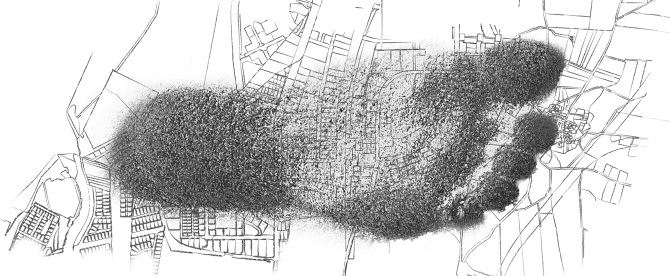
In an ever-densely populated world where massive urban migration plays a central role, the city becomes a key player within the social, economic and environmental fields. Urbanization is driven primarily by an economic vitality that finds its expression in the many job opportunities offered in the city. City population growth and the rise in standards of living with its increasing levels of consumption, further accelerate the city’s ecological footprint, whose land cover considerably exceeds its actual physical dimensions
Socio-cultural Dynamics and Changing Lifestyles
The world is in the throes of significant lifestyle change. This change is an outcome of increasing life expectancy, an increased standard of living, and the impact of technological development on society. Thanks to communication networks, it is easier to compensate for distance and knowledge gaps while smart technologies have become a significant player in the daily life of both individuals and society. These accessible factors formulate new interactions in the social structure, change the face of the family unit and propose a multi-faceted texture of relationships between the individual and society. We are witnessing a transformation from the traditional family of a heterosexual couple with children, and from a patriarchal and multi-generational family, to a ‘different family’ – a single-parent or single-sex family unit, or a family of individuals; from stable, long-term families to variable and transient relationships; and from physical friendships to the development of virtual life that forms alternative interpersonal communication systems. Society is becoming more dynamic, open and exposed to external social influences arising from the process of globalization.
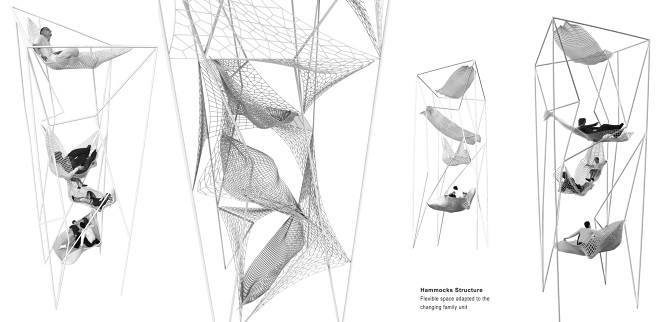
With this in mind, residence in the crowded city must be the basis for incorporating this diversification. The residential unit must respond physically and dynamically to these changes. The response could be in the form of flexible housing units, whose size may be changed according to the requirements of their owners, while maintaining the basic dimensions, in order to minimize the ecological footprint and consequent harm to exhaustible natural resources. Flexibility may come from resource sharing such as open code, by providing variable identities to private and public spaces. The shared spaces are a resource that is also flexible and may take on variable roles according to user requirements. Residences may expand in their definition and become a space that includes employment or leisure activities such as sport or culture. Physical proximity between different activities and the ability to arrange them in a non-linear way at any hour of the day significantly increases the efficiency of managing temporal and environmental resources. This program dictates a new agenda in the most literal and physical sense as well as from a broad philosophical perspective.
The Open Code City – The City in the Information Age
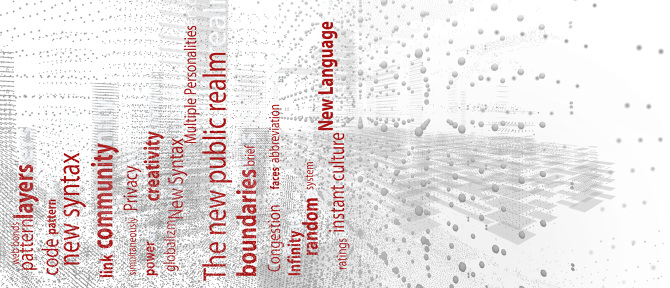
The face of society is changing: from slow development of social and cultural trends to rapid assimilation of changes; from a society based on local culture to a society feeding on and influenced by global culture; from ‘tangible life’, experienced subjectively and in the context of cultural background, to ‘virtual life’, that bridges gaps in tradition and heritage and creates new cultures. New systems form and are defined by the influential user, who, until yesterday was an anonymous and unseen user. This influence stems from bottom-up, grass-roots growth and it heralds the beginning of a social process of mutual influence of the individual on society and of society on the individual. This discourse develops and leads to user-tailored change via open-code thinking, allowing direct access to information systems, and allowing the user to directly use and change the system. This cooperation reaps the many benefits of empowerment of a system that sustains its participants. The analogy is taken from open-code development of software systems that are based on standardization as a flexible platform that enables construction of additional layers. This system encourages innovation and develops due to empowerment by many users. Tim O’Reilly described the birth of Web 2.0 as a turning point in the history of the human species. The developing work infrastructure, which he nicknamed “Architecture of Participation”, will lead, by its existence, to renewed contemplation of the society in which we live, both as a community and as an individual.
Marina Gorbis from the Institute for the Future writes in her article “Think the Unthinkable”:
"…new structures emerge little by little from the contribution of many. In this, they resemble biological structures in which complexity emerges without a grand central design." (3)
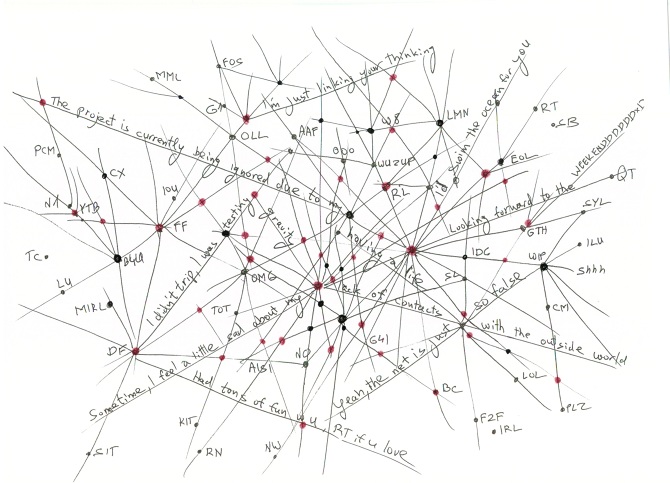
Kevin Kelly in his article 'Atom Versus Net' (4) characterizes the change in the social-cultural paradigm as a transformation from atom imagery to net imagery. In his words: 'the definitive scientific symbol of the twentieth century is the atom. It rotates by itself and symbolizes individuality. The atom is clear in its simplicity, representing power, knowledge and confidence. The atom is the past'. In Kelly opinion, the scientific symbol of the twenty-first century is the dynamic net characterized by its lack of a beginning, end, or middle. 'The net represents all the circles, intelligence, mutual dependence, economic, social and ecological issues,
communications, democracy and large groups and systems'(5). The open-code culture and the net-like distribution of the different forces embody ideological approaches that attach social value to resource sharing. Assimilation of this culture when planning our environment opens up a discussion on the status of central planning as opposed to decentralized systems, and on the impact of market forces on decision making. The open system strengthens the flexible planning alternative. Establishing a basic, standard structure allows flexibility and encourages active mixing of its users and sharing of physical resources. These approaches allow utilization of infrastructures and overall resource conservation together with broadening the personal choice
space and generating many opportunities that endorse freedom, latitude and diversity.


(2) Daffara, P. , (2004). Macrohistory and City Futures. Journal of Futures Studies, August 2004, 9(1).P. 22
(3) Gorbis, M, (2009). Think The Unthinkable, Institute for the Future, Retrieved April 29, 2014, https://www.iftf.org/node/3195
(4) Kelly, K., (2006). Atom Versus Net. Retrieved April 29, 2014, http://www.kk.org/thetechnium/archives/2006/02/atom_versus_net.php
(5) Ibid.