Architecture State of the Art?
Architecture, Proficiency and the Holistic Approach
The world of knowledge is expanding. The amount of knowledge and accessibility to information, both for professionals and the general public, are almost unimaginable; this vast amount of information cannot be adequately processed. The world is becoming increasingly professional, and research fields are becoming more focused and detailed. The scientific world, which by its nature strives towards achievements and breakthroughs, finds itself caught in an ongoing dilemma between the desire and need to specialize while acquiring in-depth knowledge of a specific subject, and the benefits derived from interdisciplinary, all-inclusive observations.
In order to deal with the wide range of challenges in architecture, as in other fields, there is a simultaneous need for specialization, corresponding with the exponential rate of technological development, and an overall view of the whole as a complex, dynamic system.
Fundamentally, architecture is a comprehensive field that encompasses a wide range of values and knowledge, integrates additional professional fields and is applied at variable scales: from the national to the regional to the local, joining forces at the structural scale and in product design. Each decision has an influence at various scales - from macro to micro. An architectural creation is a complex compilation of decisions relating to social and cultural values, philosophy, design, functionality and engineering.
The key issue in architectural planning is openness to change while preserving values. Architectural thinking must strike a balance between the local, representing permanence, and the global world, which is constantly changing. This process is analogous to ecosystems that are in a constant process of adaptation, while searching for balance and a new equilibrium during their development.
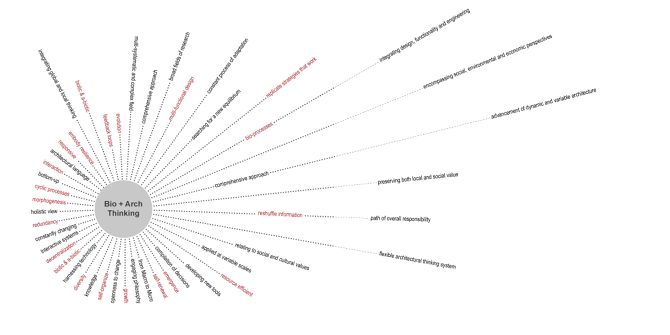
The key to architectural thinking lies in combining diverse sources of knowledge, and learning from the structure and behavior of systems across broad fields of knowledge, while integrating global and local thinking, and harnessing technology while preserving both local and social values. Architecture, as a multi-systematic and complex field, has a leadership role that, via integration and creating thinking, may lead to a path of overall responsibility, encompassing social, environmental and economic perspectives.
Architecture Between High and Low-tech
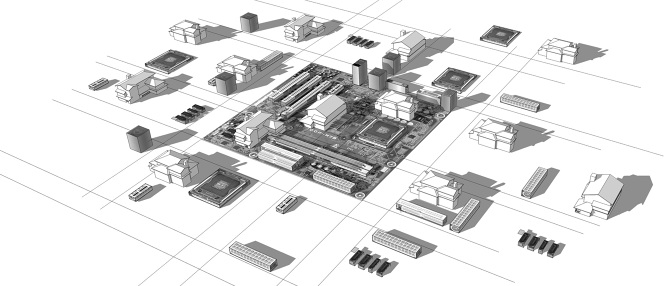
Advanced technology has been integrated en masse into most facets of life and has changed the face of society. At the same time, population growth and increased standards of living place a heavy burden on the environment and disturb the delicate balance of nature’s ecosystems. However, Building technology has advanced slowly and lags noticeably behind other facets of life. Bridging this gap requires the channeling of interdisciplinary creative thinking to provide solutions for ever-increasing physical requirements while reducing resource exploitation. The extended dialog must be based on the interaction between architecture and science, moving away from machine ideology and searching for materials and buildings with principles similar to those of ecosystems. Interdisciplinary integration will assist in developing new tools to influence both the built-up area and architectural language. This approach represents the over-arching interdisciplinary trend that examines technological capabilities and scientific principles from broad fields of research. The link between architecture, life sciences, and computer systems is the key to a more flexible architectural thinking system, and advancement of dynamic and variable architecture that deals with interactive systems and responsive environments rather than with stationary objects.