Eco / Logic
The Fragile Equilibrium of Our World
The existence of human society depends on ecological services provided by nature. In nature, ecosystems allow life to flourish by providing services that support the entire web of life whose individual elements depend on each other for their mutual coexistence. Ecosystems comprise the full spectrum of biologically diverse flora and fauna, and their interactions with each other in relation to sources of energy and minerals.
During the last fifty years, ecosystems have undergone unprecedented change, due to over-exploitation and disruption of natural resources resulting from world population growth and rising living standards.
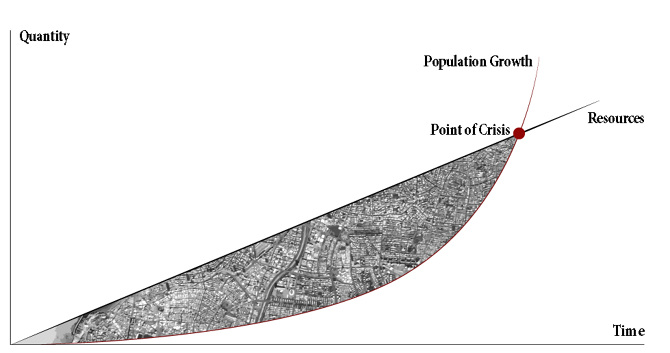
The economist Thomas Robert Malthus, in his famous 1798 manuscript, An Essay on the Principle of Population, argued that the rate of world population growth is exponential, while food supply increases arithmetically. Due to the ecosystem’s limited carrying capacity, the difference in the two graphs creates an intersection point, which is described as the 'point of crisis'. This point prescribes the upper bound for growth beyond which there is hunger, death and eventual population decline.
Malthus’s approach was rejected during his lifetime, when nature was plentiful, while products were scarce.According to the prevalent economic assumption, ecosystem services are free of charge and limitless. In our capitalist economy, no value is assigned to raw materials that originate from natural resources. This approach ignores the depletion of ‘free’ materials, the harm caused by over-consumption, the need to process the mounting waste and the extent to which nature is able to undo all the accumulated damage in order to regain its necessary balance.
Today, the picture is much clearer; some resources are insufficiently recovering from the powerful exploitation, while others are running out without any capacity for renewal. Following the general enthusiasm over the prospects of the industrial revolution, the prevalent view to problem solving from Malthus’s time until recent decades placed its trust in science and technology, in the firm belief that the future of humanity is rightly vested in them. However, in this day and age there is a pervading recognition that technology’s fast-paced development and the vast knowledge we presently possess might indeed substantially reduce the burden on ecosystems, but not sufficiently to eliminate the environmental impact that currently characterizes the over-exploitation of nature.
Alongside the growing understanding of the damage done, and the inevitably finite nature of resources, significant progress has been made in the importance ascribed to ecosystem services for humankind’s survival and wellbeing as part of a whole, balanced system.
The City as an Ecosystem
In the age of sustainability, cities are being re-conceived as ‘ecosystems’. Environments marked by a fragile balance between ‘biotic’ living organisms and the non-living ‘a-biotic’ factors of their surroundings. The ability of inhabitants to thrive in nature is dependent upon the carrying capacity of its ecosystem. Earth systems are governed by a dynamic equilibrium. The complexity of nature is derived from the contradiction between these two terms.
The URBAN ECOSYSTEM is dependent on the reciprocal relations between living elements and the infrastructure which conditions their quality of life.
These systems can be found in a variety of scales within many aspects of our lives, but a violation of their delicate balance will almost certainly instigate a process of compensation in order to regain stability.
Moving beyond the traditional binary which separates the natural from the artificial, towards a more porous integration of the biotic and the a-bioticcan imbue our cities with greater resilience and sustainability. Technology’s limited Ability to Save the World
The mounting evidence concerning the overall environmental impact provides fertile ground for debates and disagreements between those who believe that through technology we cause our ecosystems irreversible damage and devastation that is impossible to overturn, and those who believe technology is the key to saving the world. The truth, most likely, is more complex: it is located somewhere between the two extremes.
The mathematician and philosopher René Descartes believed that the purpose of science is to control nature and guarantee that technological know-how will enable humanity to claim mastery over nature. The belief that technology alone will suffice to solve the world's problems began to weaken during the 18th century with a shift in the scientific paradigm and the consolidation of the ecological approach.
The evolution of ecological thinking leans heavily on the development of modern physics, Einstein's theory of relativity, quantum physics and chaos theory. The physicist Fritjof Capra notes that : 'Quantum theory thus reveals a basic oneness of the universe. It shows that we cannot decompose the world into independently existing smallest units. As we penetrate into matter, nature does not show us any isolated “building blocks,” but rather appears as a complicated web of relations between the various parts of the whole.' (1)
The shift in the scientific approach demonstrated the dynamics and diversity in nature and the complex interactions among all the components. Instead of the mechanistic, reductionist world view, which was dominant for many years, wide range of approaches emerged that draw inspiration from the development of various scientific fields and from nature. The separation between nature and science and the condescending attitude towards nature changed and allowed a learning, cooperation and a symbiotic approach to appear and restore nature’s primordial honor with scientific insights.