Bio+Arch
Biology as a 'Model, Measure and Mentor' (6)
The prevailing worldview from ancient times until the Middle Ages was holistic, organic and ecological. Humankind, from the dawn of history, valued nature as a source of inspiration in its variety, wisdom and ability to integrate across the range of factors that maintain nature’s complex system. The study of nature was characterized by theoretical contemplation and wondering, while implementation was intuitive. The Renaissance heralded the beginnings of modern science – empirical and systematic. Descartes’ mechanistic worldview created a gap between mankind and nature and established a worldview that believes in the power of humankind over his environment. This scientific paradigm shift during the twentieth century undermined the deterministic worldview and reinstated the renewed holistic and contemplative approaches to nature to center stage. The complexity of nature and the wide range of solutions, due to 3.8 billion years’ evolution of research and development, provide diverse opportunities for inspiration.
In architecture, we can identify two fundamentally different trends of inspiration from nature: Imitation of form on one hand, and adoption of functional capabilities, organization and processes on the other. The formal-morphological or ornamental imitations of natural motifs, such as Art Nouveau or Zoomorphism, customary in architecture, are symbolic and do not leverage nature’s wisdom. In contrast, planning that evolves from in-depth study of construction or processes in nature highlights the potential embodied by this methodology. Notable examples of this approach include the pioneering work of Gaudí, who studied the structural foundations of nature and implemented them in buildings and the cradle to cradle approach to understanding natural processes and implementing them in production or when considering the building’s life cycle.
Today, we are exposed to vast knowledge and the diverse range of tools provided by science; from the cosmic scale of fundamental questions about creation of the universe to the molecular scale of medicine and biology. As architects, we have at our disposal numerous sources of information and powerful tools supported by computing capabilities, numerical patterns and architectural modeling. These tools and proficiencies, combined with ever-strengthening human knowledge allow us to utilize nature’s wisdom and develop new solutions for urban planning and architecture.
Perceiving the city as a living organism suggests looking to nature for inspiration, and develops a mechanism that can mimic nature’s dynamic means of maintaining balance and resilience.
Cancer Angiogenesis and Nanomedicine Research
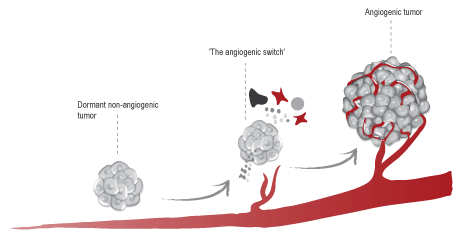
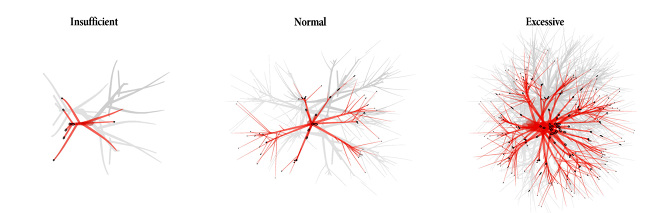
Angiogenesis, the growth of new blood vessels from pre-existing ones, is an important physiological process used for healing and reproduction. Abnormal angiogenesis, either excessive or insufficient, is associated with many diseases, including cancer, diabetes, and cardiovascular disease, amongst many others. In these cases, new ‘abnormal’ blood vessels grow and feed diseased tissues with nutrients and oxygen, provoking the destruction of normal tissues. In the case of cancer, the abnormal vessels allow the tumor mass to grow in size, and facilitate the spreading of cancerous cells into the circulation system, where they lodge in other organs and create tumor metastases(7).
Interfering with the creation of these new networks of abnormal blood vessels prevents the delivery of oxygen and nutrients, stopping the cancer’s growth. While research shows a high prevalence of microscopic cancers in healthy people, the vast majority of these small lesions will never become cancerous and deadly, because they are not able to induce the formation of new blood vessels that nourish them. Therefore, there is an urgent unmet medical need to create smart probes that detect tiny lesions before they become symptomatic, or alternatively, to find a way to regress them in a selective manner back to a dormant or normal state(8).
The suggested treatment relies on connecting existing methods to nanometer-sized smart carriers that will lead them selectively to target tumors and their surrounding network of blood vessels, and significantly reduce the amount of drugs required as well as the extent of the treatment, ultimately abrogating the side effects associated with standard chemotherapy(9).
It will eventually be possible to treat cancer patients based on a blood test, obfuscating the need to detect the tumors and their precise location. Using non-toxic nanomedicines, it may be possible in the future to treat cancer as a preventive measure before it becomes symptomatic or, in cases where one cannot be cured completely, to make cancer a chronic yet manageable disease. Understanding the interactions between tumor cells and normal cells will revolutionize the way we think about cancer, making it a curable or at least dormant disease leading to major improvement in the quality of life of those who suffer from it.
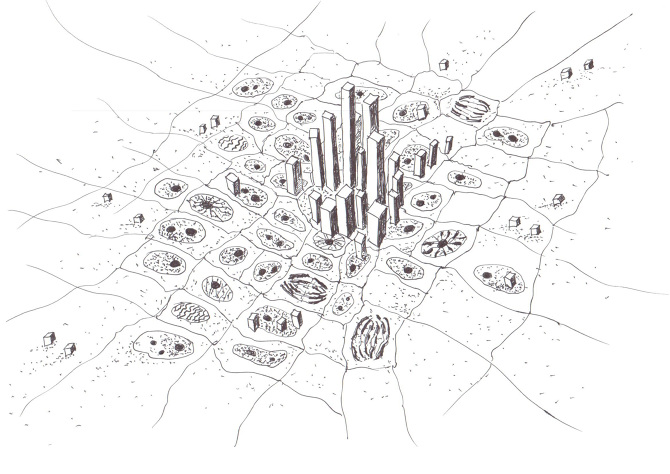
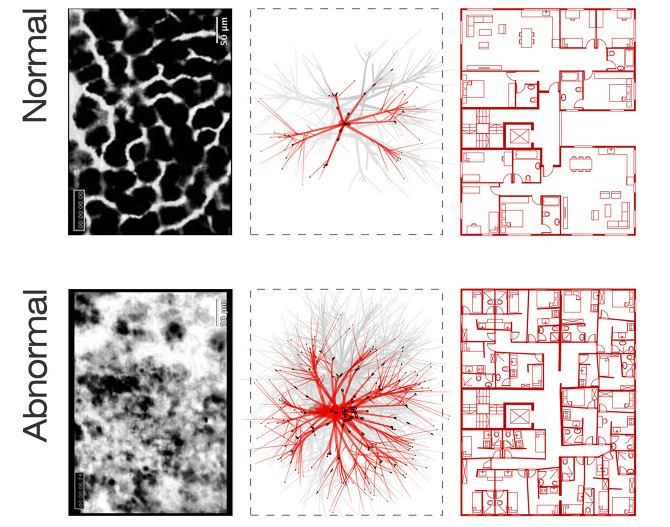
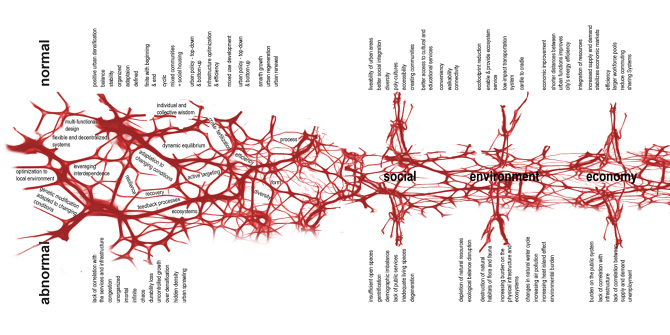
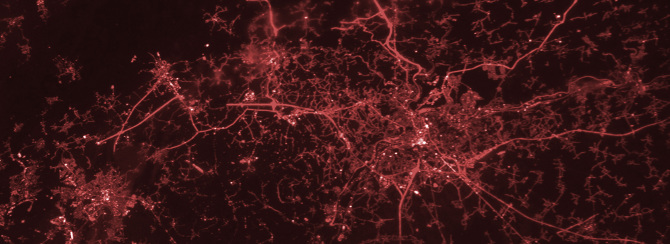
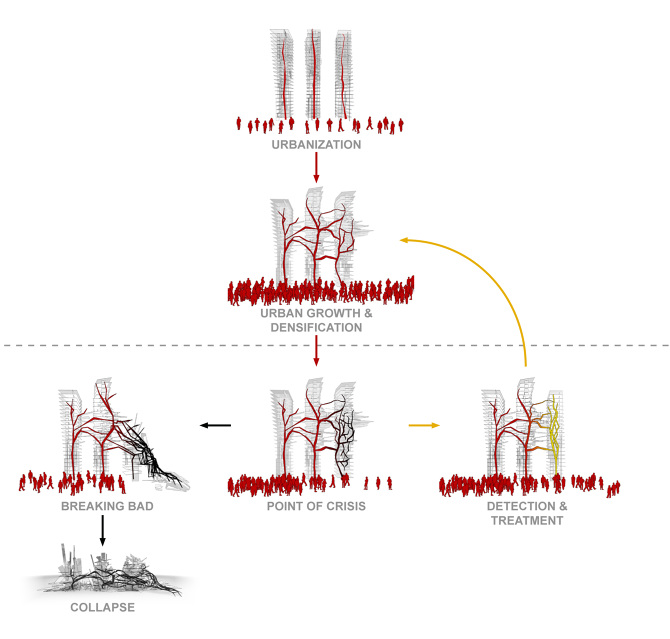
Comparing cancer tumor development with rapid urban growth exhibits similarities in both processes: In both cases if left untreated, infrastructure grows at an uncontrollable pace in order to nourish the new ‘tissue’, both within the biological and urban realms, bringing the system closer to its ‘point of collapse'.
Cancer treatment engages smart nano-probes to identify and disrupt the infrastructure created during angiogenesis to treat diseased areas before they reach their pathological stage. This begs the question; can we treat overcrowding through the identification of both healthy or unhealthy infrastructure created as a result of rapid urban growth?
The application of bio-processes challenge current planning practices, and raise questions about the ways we can control the different disorders associated with urban densification. Can we monitor existing densification, determine the problematic issues and diagnose them in time to prevent collapse? Or should we expect a ‘point of Crisis’? The challenge is to use big data to leverage the benefits of densification, strengthening the advantages while simultaneously averting the 'breaking bad' scenario.
Redefining the City - Towards Bio Smart City 3.0
When we examine the idea behind Smart City 3.0 we can see that it is supported by communication systems akin to sensory receptors in the human body. Processes in both the theoretical model and the human body are facilitated by the absorption of stimuli, and the response that follows the absorption of incoming incitements. Information gathered in the city allows us to monitor events and changing urban situations that require our response. Like the human body, where normative and pathological processes exist, the city is in a process of constant dynamic change where various processes of densification are carried out simultaneously as a new ‘tissue’ forms. In the body, there are natural mechanisms of control that monitor the natural normal development of the biological tissue. However, there are cases when this mechanism fails and the body loses its ability to cure itself. This is when pathological processes begin and in some cases overtake and destroy the system. Just like the purposed cancer treatment, that relies on smart nano-particals, the use of ‘big data’ for analytical purposes, combined with the proposed nano-technological approach, can be applied to urban zones, sending 'intelligent agents' to identify, detect and treat the affected area without destroying healthy tissues. These tools can prevent the development of destructive pathological phenomena, and strengthen the healing processes through a focused treatment suitably adapted to local problems.
Making the analogy between the biological research and urban planning constitutes a call to learn from physiological and pathological processes in nature and explore how we can harness the wisdom of nature and science for the benefit of planning and architecture. Just as the proposed cancer treatment uses the already accruing process in the body for the benefit of the treatment, Smart city 3.0 should use the evolving and accumulated data and information to provide targeted solutions for local situations. Integrating responsive technology that will react to a variety of issues and events is the key for establishing balanced, stable and resilient cites, all the while introducing a new social and environmental approach to the nature-human ecosystem.


(6) Benyus, J.M., (1997). Biomimicry:innovation inspired by nature. New York, Quill.
(7) Judah Folkman, Tumor Angiogenesis: Therapeutic Implications, N Engl J Med 1971; 285:1182-1186.
(8) Tiram G, Segal E, Krivitsky A, Shreberk-Hassidim R, Ferber S, Ofek P, Udagawa T, Edry L, Shomron N, Roniger M, Kerem B, Shaked Y, Aviel-Ronen S, Barshack I, Calderón M, Haag R and Satchi-Fainaro R, Identification of Dormancy-Associated MicroRNAs for the Design of Osteosarcoma-Targeted Dendritic Polyglycerol Nanopolyplexes, ACS Nano 10(2): 2028-2045 (2016)
(9) Satchi-Fainaro R, Puder M, Davies JW, Tran HT, Sampson DA, Greene AK, Corfas G, Folkman J: Targeting angiogenesis with a conjugate of HPMA copolymer and TNP-470. Nat Med 2004, 10(3):255-261.